Friday, April 4, 2014

Explain the evolution of uniform urban landscapes: the effects of common commercial activity, structures, styles of construction and infrastructure.


           Uniform urban landscapes mean that the Homogenization of landscapes is occurring. Homogenization is the process in which people, products and places become the same. Urban landscapes are becoming the same. They have same infrastructures, same stores and companies in the cities. The towns are dominated by chain stores which make all the towns look similar. These towns are called clone towns. Dubai is a great example of a uniform urban landscape.
         30 to 50 years ago, people in Dubai used to live like nomads and lived in tents. Their economy was moderated by fishing, pearl diving, date farming and camel herding. The life of 7star hotel was something that is so far off from the lifestyle in 1970s at Dubai. Now Dubai is considered as one of the most advanced city in the world. This title “one of the most advanced city” was given to the city because Dubai looked just like New York or other large cities.
Dubai in 1980s
external image dubai-old-photo.jpg
         Dubai now has 7star hotel which is the only 7 stared hotels in the world. Lots of malls with Transnational Corporations are thriving in the city of Dubai. The airlines like Emirates have increased the tourism in Dubai. Dubai started to host global sporting events such as IRB Rugby sevens, Race to Dubai Golf and ATP Tennis.
Dubai Today
external image burj-khalifa.jpg

         Number of cities is increasing however their uniformity do not change. This leads to more and more clone towns that have no unique taste or culture. 

Tuesday, March 25, 2014

Outsourcing

Outsourcing is a technique used by companies to bring in the outside firms with money and make them handle internal company functions. Outsourcing is used to reduce costs, Improve quality of service, focus on core business, avoid health insurance for workers and etc. With the development of technology Outsourcing comes in more various forms. Call centers are one form of outsourcing. Call centers deal with customers who has inquiries through phone calls. Booking a flight, buying a theater ticket, and complaining about a product are jobs that are handled by call center workers. Philippines and India are lead countries in number of employees and income by call centers. Philippines is a great outsource for companies because of the cheap labor cost and ability of Filipinos to speak fluent English. Philippines is looking forward for a better income from call centers by increasing the work force and developing technology that make better calling condition for the workers and the customers. I heard that the income for average call center worker is 12000 pesos per month.
The Teleserv call centre

Question: Are Filipinos who want to learn English and American accent due to employment a form of imperialism? 

Thursday, March 20, 2014

Political Outcomes

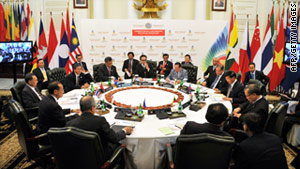
Foreign Ministers and representatives from ASEAN's 10 member nations meet in Jakarta, Indonesia, on Tuesday.


Summary: Association of Southeast Asian Nations will send observers to Thailand Cambodia border, where old temple is located which is the center of dispute.
10 nation members of the ASEAN met in Jakarta to discuss the conflict between Cambodia and Thailand.
The area of conflict is the site of Preach Vihear. The temple in the site was told to be awarded to Cambodia but Thailand says that the area around the temple has not been clearly demarcated.
The teams will be sent to the conflict zone to ease the conflict and prevent further clashes.


Thoughts: The Association of Southeast Asia seems to ease the conflict that is happening between the countries in Southeast Asia. They are trying to ease the conflict between the Cambodia and Thailand. They are both part of this multi-governmental organization. Just looking at this conflict there is no problems or negativity of multi-governmental organizations. They are present to regulate the things that happen between the countries that are part of the organization. In this case, they are trying to stop the conflict between two countries which could be an act of peace making. I did not know about this organization before. I think that this is like the small UN that operates in South East Asia.

Wednesday, March 12, 2014

Choose either the concept of cultural diffusion (voluntary/consented change in culture) or cultural imperialism (enforced/pressured change in culture) and using specific examples explain how transnational corporations either intentionally or unintentionally spread consumerism through your chosen concept.

Cultural diffusion is the process which ideas of a particular culture are spread throughout the culture that the ideas were not originated from. In short, the ideas of a particular culture are shared with other cultures. Transnational corporations are the leaders of this process and they either intentionally or unintentionally spread consumerism through cultural diffusion. Tomlinson quoted that Third World consumers were said to be coerced to buy goods – jeans, watches, perfumes, televisions – which had no real meaning for them and played no authentic role in their culture.

           The Barbie dolls, Junk food, designer jeans, and Playboy magazines are great examples of things that symbolize materialism. These are things that people can live without. Large transnational corporations spread products that make people materialist. People can live without Jeans but many corporations make jeans which are originated from America. In the Philippines which is more than 10 hours apart by flight has lots of malls with lots of clothing shops such as Guess, Boss, and Diesel which are shops that sell jeans. This shows the power of cultural diffusion and how the transnational corporations have made people buy jeans which is a sigh of consumerism. Flashy commercials with world stars lead to people buying the product which is an act of promoting consumerism. 


Reference: http://www.david-howes.com/CultCon/OverView.htm

Thursday, March 6, 2014

Pros and Cons of Globalization

Very few companies are based in one country


Pros
Cons
Sharing information and technology allows the less developed countries develop at the same speed as the developed nations.
Many people from the developed nations are losing their jobs because the corporations move out to other countries to find cheaper work force. European factory workers lose their jobs because the corporation set up factories in china or other African countries to take advantage of the cheap work force.
Worldwide market allows people to get easy access to goods from different countries.
(Samsung in Philippines)
Psychological threat is given to the workers in developed nations because they have to suffer from the threat that they could be fired from the job at any time.
Culture of different countries is shared and many countries learn the culture of different countries. This increases the understanding between countries and people. (Pandesal patty in MacDonald in the Philippines.)
There is a threat that the corporation could rule the world because they have so much money and power. Some companies are richer then countries.
With the frequent interaction with people from different areas, socially people become more open and tolerant. People from other countries become easier to approach.
The globalization could lead to lose of culture because most of the companies come in to companies with western ideas. People start to learn and cope with the eastern culture and this could lead to losing one’s unique culture.
Companies get wider range of customers since their products can easily be sold at different countries. (McDonald, Guess, Gucci)
Since it is easy to move from different areas, the risk of communicable disease increases. This is the reason why airports have fever detecting sites when people arrive to different countries. Spread of disease became easier.

Tuesday, December 10, 2013

Why is it that the rich get richer and the poor stay poor?


Rich are the ones who are in the top 1 percent. We cannot say that middle class people are rich because of the wealth gap between the top 1 percent and the top 10 percent. Riches continue to become rich because they have the resources and they teach their offspring how to use and keep the money. They own more and more things on earth and they pay the people who work for them. The poor people who work for them gets the money from the rich boss which makes them stay as a worker. No matter how hard they try, they only get a tiny portion of the boss's money. With the riches controlling the price of the goods, excellent education, and housing, it is impossible for the poor to use and live the life of the riches. They may buy the products but then that is just helping the rich get richer. with out the excellent education that rich children get, it is hard to become rich. Poor people get worse and worse condition of life style because of the increasing prices of goods and services. Poor stays poor because the only way for them to change their lifestyle is education but the quality of education given to the rich children are different and better then the education given to the norms. 

Tuesday, November 12, 2013

Writing prompt

1. Why have some countries donated more in aid to the victims of Typhoon Haiyan than others?

Some countries have more money compared to other countries. This means that they have more extra money to help other countries and gain good reputation as a helping country. Some countries might have conflict with the Philippines and donate less money even if they are affluent. Aid helps countries to build positive relationship. Once the country that aided Philippines are devastated by a natural disaster, Philippines will help the devastated country. For the countries that help, aiding Philippines could be like a saving that they will be using once they are affected by the same disaster. 

2. How does the aid being sent to victims of Typhoon Haiyan represent the following:

altruism- Countries donated large amount of money to the victims of the Philippines. Since its "donation" nothing in return is expected by the donor countries and this shows altruism. 

geopolitics- Since different countries around the world aided Philippines  this shows the geopolitics. Money donated to the Philippines from countries are money from the government and this shows that politics has to do with this aiding. Relationship between Philippines and other countries are shown in the amount of money donated. The amount depends on the GDP however some countries with high  GDP sent minimal amount of aid probably due to the long standing conflict with Philippines. 

neo-colonialism?